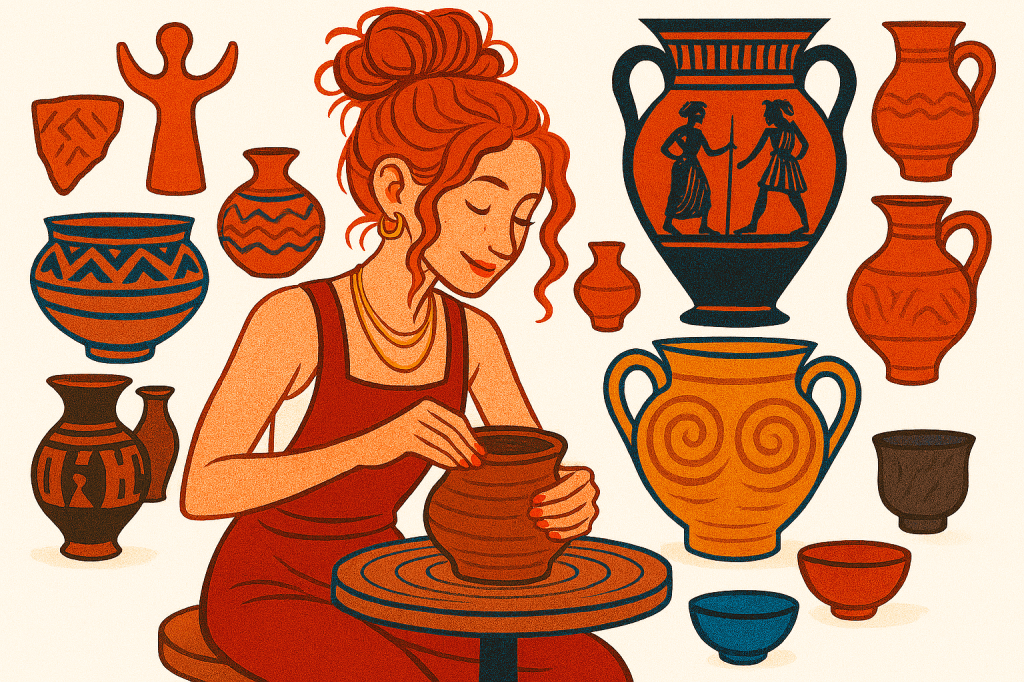
I’m in my expression phase and obsessed with finding different forms of expressions in the art world. While looking for a new medium to try, one of the many ones I’ve come across is ceramics. Before I start anything new, I need to know the history of it and decided I needed to share a bit of ceramics history. It’s absolutely fascinating. Ceramics is one of the oldest art forms humans have ever created. It’s older than written language, older than any metal work, and older than most myths we still tell today. It’s an art form that refuses to disappear and is constantly reinventing itself all while managing to stay rooted in the same elemental truth of storytelling. Clay plus hands equals a story that translates just like words would.
The earliest ceramics date back to over 20,000 years. Before pottery was art, it was survival. People shaped and used clay as vessels to store water, grain, and food. They fired it to make it strong enough to withstand weather, time, and travel. They carved symbols into it which were marks that became some of the earliest forms of communication. Ancient pottery is like humanity’s first scrapbook. Every shard that archaeologists dig up is a clue of what people believed, what people ate, and how they lived. Even the broken pieces carry a meaning. Clay tends to remember what humans forget. Ceramics weren’t just functional, it was cultural memory baked into the earth.
Ceramics are both functional and spiritual. Across many civilizations, from China to Mesopotamia to the Americas, ceramics have always lived in a beautiful duality. A bowl isn’t just a bowl. A vessel isn’t just a vessel. Ceramics hold many more meanings. Ceramics can be an offering to gods. It can contain the ashes of ancestors. It can be decorated with symbols of protection, wealth, health, and more. It holds stories of its creations while also holding everyday meals shared between families. Clay has blurred the line between the sacred and the mundane. It’s practical enough to use daily and spiritual enough to honor the divine. That duality is why ceramics have never and will never go out of style. It adapts to the meaning that cultures need.
Ceramics have evolved through cultures as society has grown. Clay traditions adapted. China has perfected porcelain, which is thin, luminous, and impossibly strong. Japan developed raku, which is earthy, imperfect, and deeply tied to tea ceremony and mindfulness. Ancient Greece used pottery as literal storytelling devices with black and red figure scenes that documented their daily lives and documented myths. Indigenous cultures across the Americas created pottery that honored their sacred land, cosmology and lineage. Every culture shaped clay differently but the intention was always the same, to make something that lasts. Ceramics are a cultural fingerprint, a way to understand people long before we ever existed.
Modern ceramics has also become a therapy of sorts but one you can hold. It helps ground us in a world that seems to move so fast you can’t keep up. Modern ceramics have been found to have many therapeutic reliefs. For instance, the weight of clay has been found to calm the nervous system. The wheel can help you with breathing because of the rhythm. The kiln is a metaphor for transformation. The process of the consistent movement to shape clay is like meditation. Ceramics is one of the few art forms where your whole body can participate. Your hands lead, your breath, posture, and presence follow suit. It’s therapy disguised as a craft and is a way to return to yourself with touch, patience, and repetition.
Ceramics endures because it’s human. It cracks. It breaks. It gets revision and remade. It holds stories, secrets, and fingerprints. It’s functional and spiritual. Ceramics are ancient and modern. It’s fragile and resilient. Clay survives because we keep returning to it. Not so much out of nostalgia but because it gives us something we still need. It’s a way to feel connected, embodied, and alive.
XOXO,
Savi Monroe
Here are just a few links to check out some modern and ancient clay.
 Savi Monroe XO