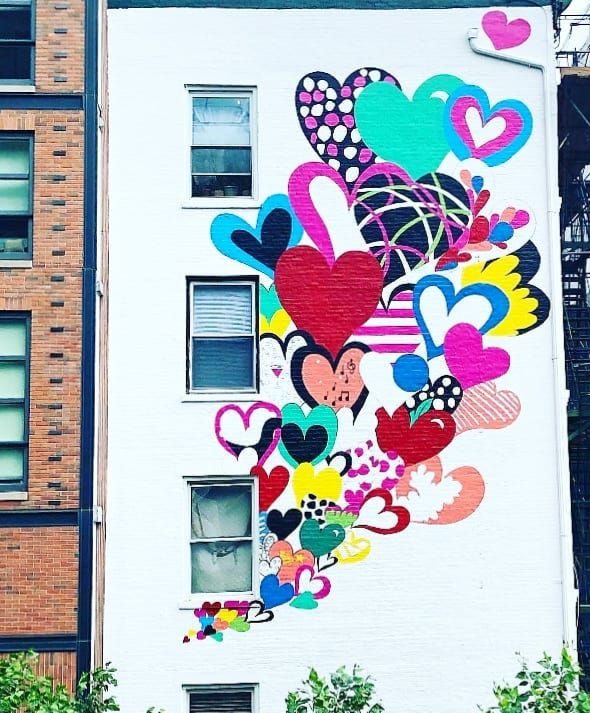
Street art has always been louder than paint. It’s a pulse, a protest, a love letter, a confession, or even a warning. It’s the moment someone decides that their feelings deserve a wall, not a whisper. When you trace history, you realize street art isn’t just about color or style. It’s about emotion made public. Here’s to a journey through how graffiti, murals, and public art became the world’s most democratic emotional archive. That’s why it’s perfect for my next installment of my series of exploring different art mediums.
Graffiti is rebellion, identity, and a community. Graffiti didn’t start as vandalism. It started as a voice. From ancient inscriptions on Roman walls to subway tag explosions of the 1070’s New York, graffiti has always been a way for people to say…. I exist, and you will see me. Graffiti is rebellion. It’s an art form that refuses permission. It’s the teenager with a marker that has something to say. It’s the community pushed to the margins. It’s the artist who knows that visibility is power. Tagging a wall is a way for someone to reclaim space in a word that often tries to shrink you.
Graffiti’s identity lets creators build entire personas through their tags, names, symbols, and styles. It’s branding before branding. Its alter ego is survival. Every tag is a signature but also a story. It’s about where you’re from. Who you run with. What you believe in. Its community as well. Despite the stereotype of lone vandals, graffiti culture is deeply communal. People form crews. Styles evolve together. Walls become conversations. Street art is a social language. A language that thrives on collaboration, shared codes, and competition.
Street art is also murals on a public scale. If graffiti is the shout, murals are the speech. Murals have been used for centuries to tell stories that matter. It’s about political movements, cultural pride, collective grief, collective joy, and neighborhood history. Murals have also been used as memories. Something like Diego Rivera’s sweeping frescoes or the Chicano mural movement in Los Angeles. These works aren’t just decoration, they are documentation. Murals preserve what communities refuse to let be forgotten.
Murals can also heal. Modern murals often honor victims, uplift local voices, or reclaim neglected spaces. A mural can turn a black wall into a beacon. It turns a street corner into a sanctuary. They can also be used as dialogue. Unlike art museums, murals seem to talk to people not at them. They live in the weather, the noise, the foot traffic. They change as the neighborhood changes. A mural is a story that never stops being read.
Public art is the great equalizer. It asks nothing of you. You don’t have to buy a ticket to experience it. There’s no dress code or art degree required. It gives beauty freely. It transforms the ordinary into the extraordinary. When art lives in public, it becomes part of a collective emotional landscape. It empowers communities and sharpens their own visual identity. Street art democratizes beauty but refuses to hide it behind walls. It matters because it gives emotions a place to go. Street art is the heartbeat of public life. It’s messy, loud, layered, imperfect, and deeply human. It reminds us that beauty doesn’t need permission. It just needs a surface. Below are some links I thought some of you may like to see to explore street art.
XOXO,
Savi Monroe
Street Art & Mural Open Calls | The Street Art List
Top 10 of the best Street Art Festivals across the globe
StreetArtNews – Daily coverage of everything new in Urban and Street Art
 Savi Monroe XO