As part of my art history series, I thought this topic would be fun to talk about next. Before we had feeds, timelines, and share buttons, we had ink, pressure, and a whole lot of ingenuity. Long before the internet connected billions of people, printmaking connected entire societies by spreading images, ideas, gossip, political messages, and even memes. Yes, medieval memes were a thing. Printmaking wasn’t just an art form, it was the world’s first mass communication engine.
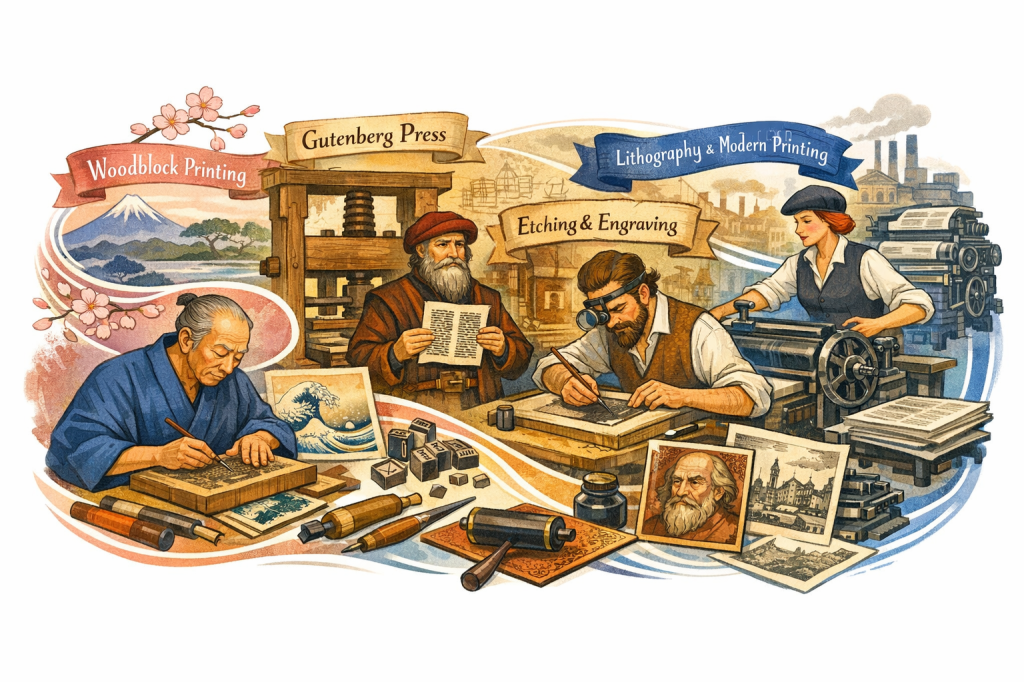
Printmaking has roots that stretch back over a thousand years. Woodblock printing, for instance, first appeared in China in the 7th century, used to reproduce Buddhists texts and images. It was slow, meticulous, and revolutionary. Suddenly knowledge didn’t have to be rewritten by hand. By the 14th and 15th centuries, woodcuts spread across Europe, becoming the go to method for illustrating books, religious imagery, playing cards, and even early news sheets.
Etching emerged in the early 1500s, when artists realized they could draw directly on metal plates coated in wax, then let acid do the carving. This made for more detailed images that could be expressive and personal. The renaissance version of a curated Instagram grid. Lithography arrived in 1796, invented by Alois Senefelder. It allowed artists to draw freely on stone with greasy crayons and produced images fast and cheap. Lithography was basically the printing press meets photocopier meets meme generator.
Each new technique made images easier to reproduce and easier to spread. Woodcuts were bold, graphic, and easy to reproduce. They appeared everywhere like religious pamphlets, early newspapers, posters announcing events, political satire, and illustrated stories. If you saw a woodcut nailed to a door or passed around a market, you were essentially seeing the 1400s version of a viral post.
Etching lets artists get personal. The lines were delicate, emotional, and full of nuance. Artists like Albrecht Durer and Rembrandt used etching to share ideas, self portraits, and commentaries on society. These prints traveled across borders, inspiring artists who had never met. It was the first global creative network. Lithography made printing fast, cheap, and wildly accessible. Suddenly posters could be mass produced. Sheet music was able to spread rapidly. Advertisements exploded and political cartoons reached masses. Color printing, called chromolithography, made images even more irresistible. Think of lithography as the moment the algorithm changed everything got louder, brighter, and more shareable.
I know it’s a crazy thought for the younger generations, but artists were able to spread ideas before there was internet. They didn’t need WiFi to go viral. They had traveling prints that moved through trade routes. They had workshops that produced hundreds of copies of information they needed to get out. Collectors shared prints with each other instead of sending links. There was public posting in town squares. Books and pamphlets illustrated reproducible images. Political prints were even circulated during revolutions. Prints were portable, affordable, and endlessly reproducible. One image could travel from city to city, sparking conversations, influencing fashion, shaping public opinion, or inspiring other artists. Sound familiar?
Printmaking created the first global creative community long before hashtags. This all matters because in a world obsessed with “new” printmaking reminds us that creativity has always been social. Artists have always found ways to share their voice. Technology has always shaped how ideas spread. Community has always been the art engine. Printmaking is proof that humans are wired to connect through images, stories, and shared information. It’s the original social media, and honestly, still one of the most magical.
XOXO,
Savi Monroe
 Savi Monroe XO