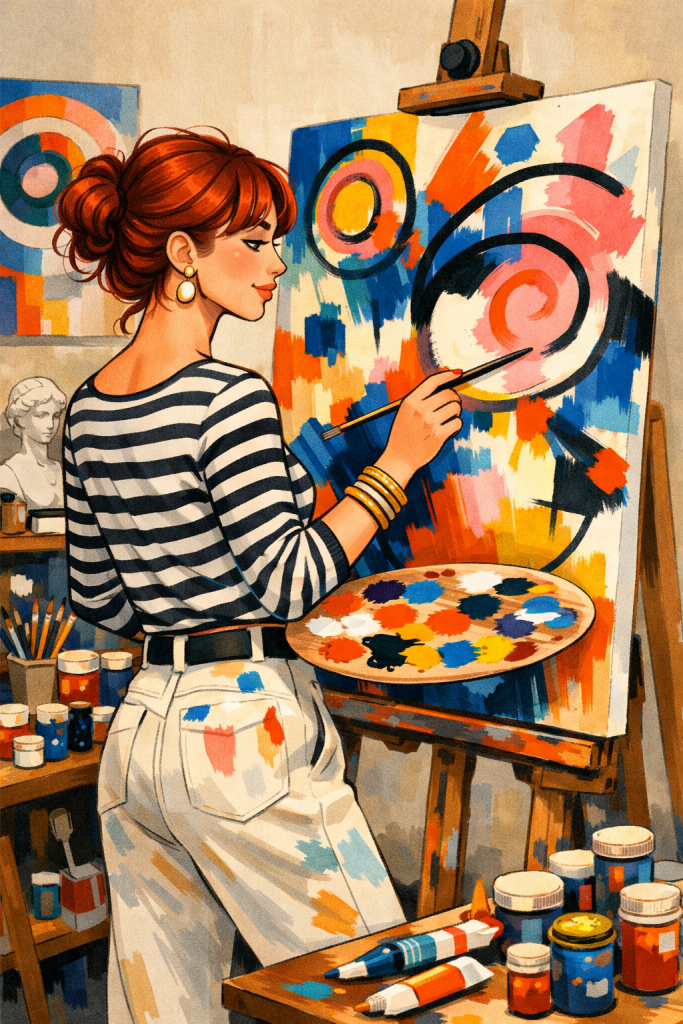
There are moments in cultural history when the collective vibe shifts from “we can fix this” to “absolutely not, I’m done.” The early 20th century was one long, dramatic eye roll. After centuries of painting the visible world kings, fruit bowls, religious scenes, and the occasional horse doing the most, artists began to feel that realism was basically the artistic equivalent of small talk. Polite, predictable, and deeply insufficient for the emotional chaos of modern life.
Industrialization was roaring. Cities were swelling. Science was revealing invisible forces like X‑rays, radio waves, and electromagnetic fields. Freud was out there telling everyone their subconscious was running the show. Spiritualist circles were hosting séances in living rooms. The world was expanding in ways that couldn’t be captured with perspective and shading. So, artists did what artists do best, they collectively snapped and abstraction was born.
The Cultural Exhaustion That Led to Abstraction
By 1900, realism felt like a lie. The world was messy, fast, fragmented, and emotionally overloaded. The old artistic vocabulary “paint what you see” suddenly felt like trying to describe a thunderstorm using only the word moist. A few key cultural pressures pushed artists over the edge.
Photography stole realism’s job. Once cameras could capture life with perfect accuracy, painters were like, “Okay, so… what now?” Fun fact: some early critics literally panicked that painting was “dead.” Spoiler…it wasn’t. Science revealed invisible worlds. X‑rays (discovered in 1895) blew everyone’s mind. Suddenly, the idea that art had to show the visible world felt outdated. If science could see through skin, why couldn’t art?
Spiritualism and mysticism were trending. Séances, automatic writing, theosophy people were obsessed with the unseen. Artists wanted to paint the spiritual, the emotional, the energetic. World War I shattered the illusion of order. After the war, the idea of painting a peaceful landscape felt almost delusional. Abstraction became a way to express trauma without depicting it literally. Abstraction wasn’t just a style shift. It was a cultural exhale, a refusal to keep pretending that the world was neat, rational, or fully knowable.
Wassily Kandinsky — The Synesthesia King
Kandinsky believed color had spiritual power. He claimed he could hear colors and see sounds, a form of synesthesia. His paintings were meant to function like music, not describing the world but moving you emotionally. Fun fact…Kandinsky wrote one of the first manifestos for abstract art in 1911, basically saying, “Realism is cute, but I’m painting the soul now.”
Hilma af Klint — The Secret Pioneer
Decades before Kandinsky, Hilma af Klint was creating enormous, swirling, symbolic paintings guided by spiritualist practices. She believed she was channeling messages from higher beings. Fun fact…. She asked that her abstract works not be shown until 20 years after her death because she believed the world wasn’t ready. She was right, when her work finally debuted, it changed art history.
Mark Rothko — The Emotional Atmosphere Architect
Rothko stripped painting down to floating fields of color that somehow say everything without depicting anything. His canvases aren’t images; they’re emotional climates. Fun fact….Rothko insisted his paintings be hung low so viewers felt inside the color. He wanted you to stand close enough that the painting swallowed your peripheral vision.
All three artists rejected the idea that art must imitate life. Instead, they insisted that art should illuminate the inner life, the messy, mystical, unphotographable parts of being human. Abstraction mirrors emotional processing and resonates because it mirrors how we actually experience emotion. It’s not in tidy narratives, but in waves, colors, intensities, and contradictions. Emotions rarely arrive with clean edges. They blur. They overlap. They contradict themselves. Abstract art gives form to that internal chaos without forcing it into a literal storyline. When you stand in front of a Rothko, you’re not “looking at” something — you’re feeling with something. When you follow the spirals of Hilma af Klint, you’re tracing a psychological map. When Kandinsky’s colors collide, you’re witnessing emotional frequencies. Abstraction is what happens when culture and the people inside it finally admit that the inner world is just as real as the outer one.
XOXO,
Savi Monroe

